by Marco Picone
Texture Paste and Pouring on Canvas
24” x 18”
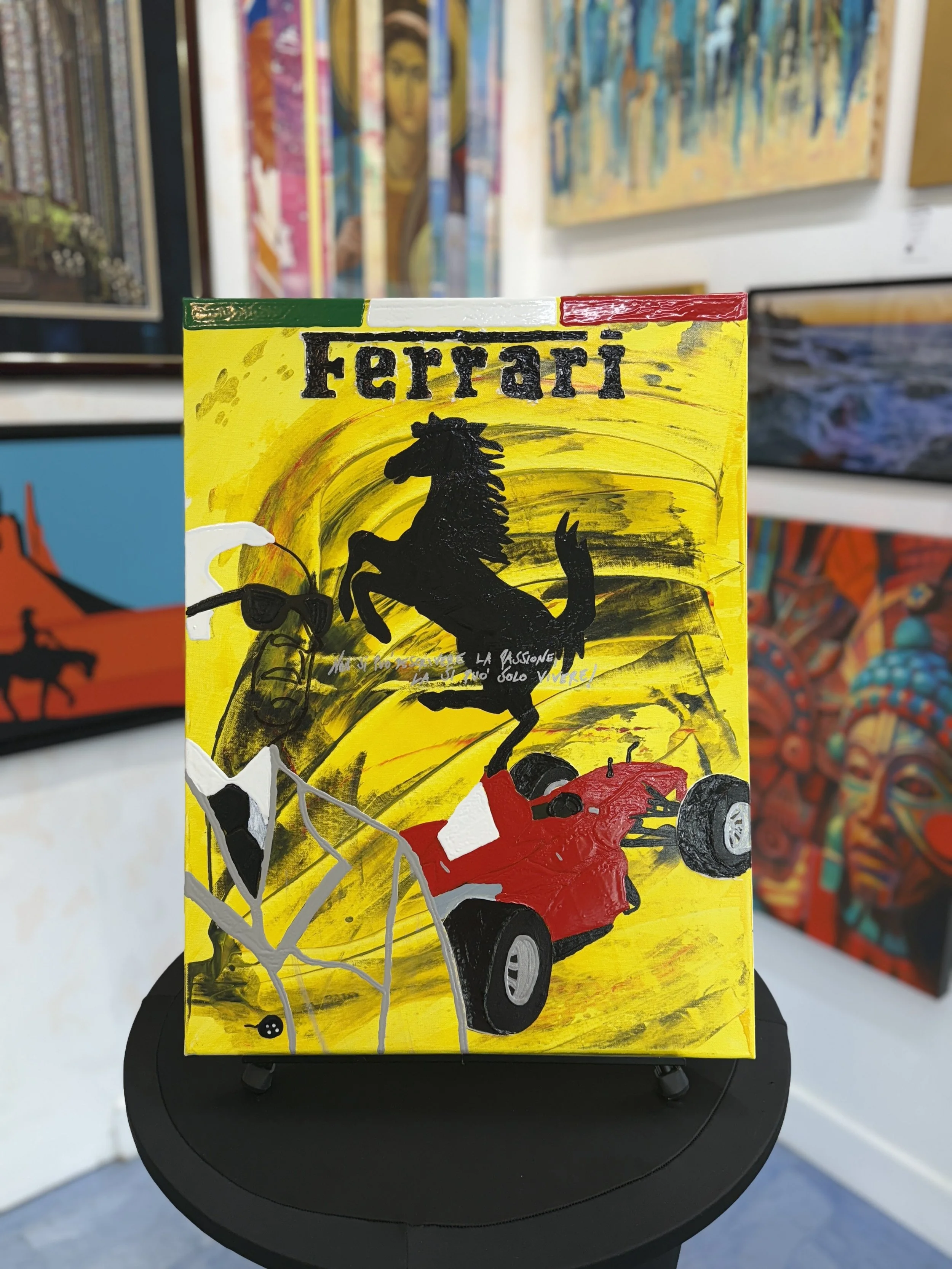
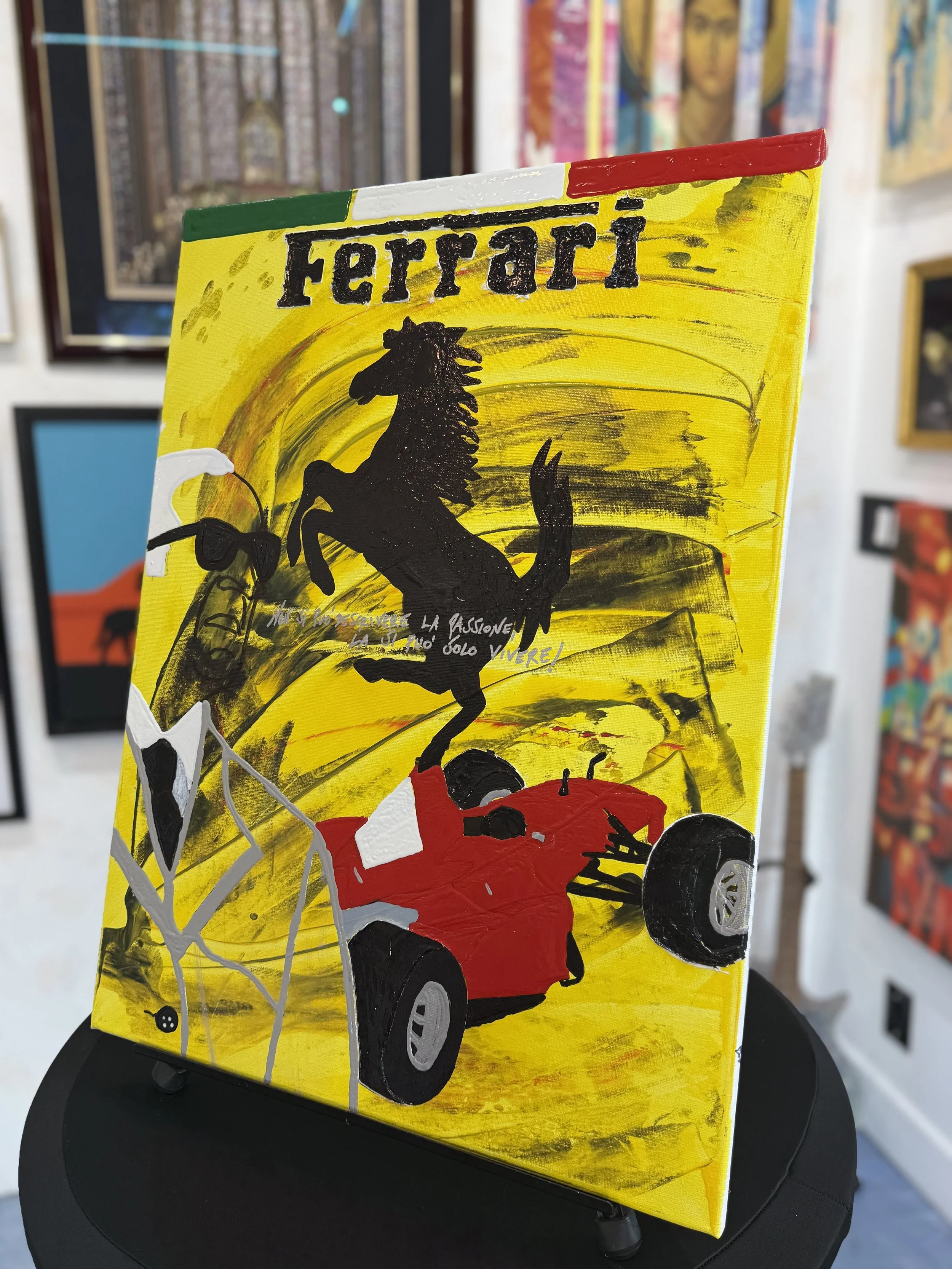
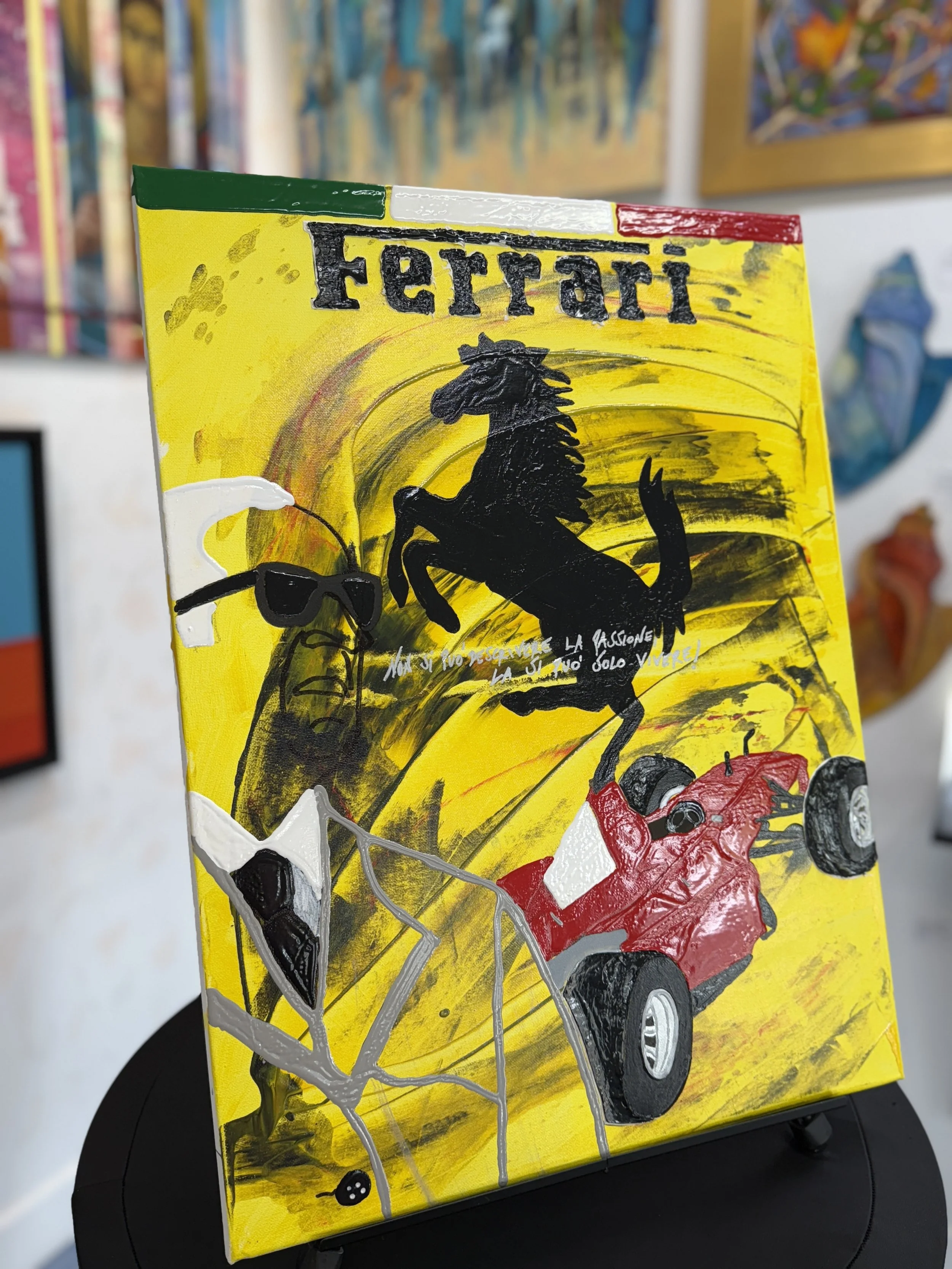
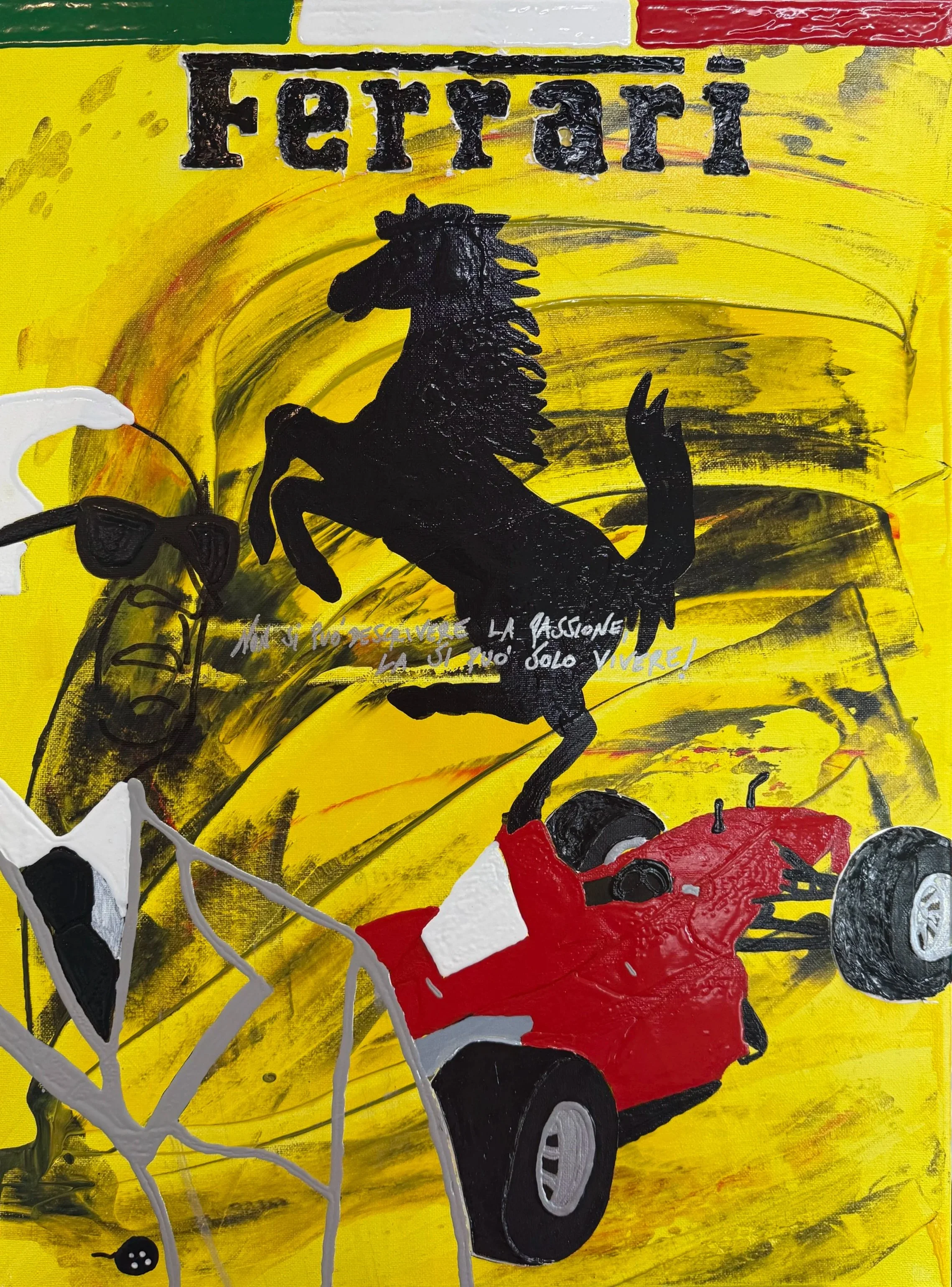
The artwork is built through multiple symbolic layers. The yellow background recalls Modena, Enzo Ferrari's birthplace, whose historic yellow became one of thevisual identities associated with Ferrari itself. On the left side of the work, the portrait of Enzo Ferrari represents the human presence behind the legend: the individual whose determination and personal vision created something that extended far beyond automobiles. At the center of the composition emerges the prancing horse, one of the most recognizable symbols in modern history. Its origins connect directly with aviation history through Francesco Baracca, the Italian World War I aviator who painted the horse on his aircraft. The symbol was later entrusted to Enzo Ferrari and transformed into an emblem of speed, identity, and aspiration. As a former military pilot myself, I felt a strong personal connection with this historical relationship between aviation and Ferrari's identity. The red Formula 1 car symbolizes movement and the racing spirit that shaped Ferrari's legacy. The color itself is not arbitrary; it recalls the historic "Rosso Corsa," the racing red traditionally assigned to Italian cars in international competitions. More than a color, it became a visual language associated with energy, passion, and national identity. The phrase “Passion cannot be described, it can only be lived” reinforces the emotional dimension of the piece. I wanted this work to represent Ferrari not as an automotive brand, but as a force capable of connecting engineering, emotion, memory, and culture.
Artist Biography
Marco Picone is an Italian contemporary artist currently based in the United States. A former Lieutenant Colonel and pilot in the Italian Air Force, his artistic practice emerged from a profound personal transition: leaving Italy, aviation, and his former life behind to follow love and rebuild identity through art.
His works combine texture, pouring techniques, sculptural surfaces, and unconventional canvas forms to create emotionally charged visual narratives. Through symbols deeply connected to Italian culture, memory, speed, fashion, and transformation, Picone explores themes of passage, displacement, identity, and emotional evolution.
His work seeks to transform painting into a physical and emotional experience where material itself becomes part of the storytelling.
Artist Statement
I do not paint objects or brands as symbols of luxury alone. I paint what they represent emotionally and culturally.
My work is deeply connected to Italian identity, memory, movement, and transformation. Ferrari, Valentino, Vespa, aviation, migration, and human relationships become visual languages through which I explore personal transition and emotional passage.
I use texture paste, pouring, sculptural material, and irregular surfaces because I believe emotions cannot exist inside perfect boundaries. The physicality of the work becomes part of the narrative itself.
After leaving Italy and moving to the United States, painting became a way to process distance, change, nostalgia, and reinvention. Every artwork is both personal and symbolic — suspended between past and future, heritage and transformation.
by Marco Picone
Texture Paste and Pouring on Canvas
24” x 18”
The artwork is built through multiple symbolic layers. The yellow background recalls Modena, Enzo Ferrari's birthplace, whose historic yellow became one of thevisual identities associated with Ferrari itself. On the left side of the work, the portrait of Enzo Ferrari represents the human presence behind the legend: the individual whose determination and personal vision created something that extended far beyond automobiles. At the center of the composition emerges the prancing horse, one of the most recognizable symbols in modern history. Its origins connect directly with aviation history through Francesco Baracca, the Italian World War I aviator who painted the horse on his aircraft. The symbol was later entrusted to Enzo Ferrari and transformed into an emblem of speed, identity, and aspiration. As a former military pilot myself, I felt a strong personal connection with this historical relationship between aviation and Ferrari's identity. The red Formula 1 car symbolizes movement and the racing spirit that shaped Ferrari's legacy. The color itself is not arbitrary; it recalls the historic "Rosso Corsa," the racing red traditionally assigned to Italian cars in international competitions. More than a color, it became a visual language associated with energy, passion, and national identity. The phrase “Passion cannot be described, it can only be lived” reinforces the emotional dimension of the piece. I wanted this work to represent Ferrari not as an automotive brand, but as a force capable of connecting engineering, emotion, memory, and culture.
Artist Biography
Marco Picone is an Italian contemporary artist currently based in the United States. A former Lieutenant Colonel and pilot in the Italian Air Force, his artistic practice emerged from a profound personal transition: leaving Italy, aviation, and his former life behind to follow love and rebuild identity through art.
His works combine texture, pouring techniques, sculptural surfaces, and unconventional canvas forms to create emotionally charged visual narratives. Through symbols deeply connected to Italian culture, memory, speed, fashion, and transformation, Picone explores themes of passage, displacement, identity, and emotional evolution.
His work seeks to transform painting into a physical and emotional experience where material itself becomes part of the storytelling.
Artist Statement
I do not paint objects or brands as symbols of luxury alone. I paint what they represent emotionally and culturally.
My work is deeply connected to Italian identity, memory, movement, and transformation. Ferrari, Valentino, Vespa, aviation, migration, and human relationships become visual languages through which I explore personal transition and emotional passage.
I use texture paste, pouring, sculptural material, and irregular surfaces because I believe emotions cannot exist inside perfect boundaries. The physicality of the work becomes part of the narrative itself.
After leaving Italy and moving to the United States, painting became a way to process distance, change, nostalgia, and reinvention. Every artwork is both personal and symbolic — suspended between past and future, heritage and transformation.